


I’ve been hiring over the past six months, meaning I get to speak to a lot of product and growth managers about their jobs.
I also have to explain to engineering who we’re hiring and why.
The conversation goes like this:
Me: We’re hiring growth and product managers
Engineer: What will their role be?
Me: Just like mine.
Engineer: Okay. But what do you do, Rosie?
Greaaaat question.
And they don’t ask because I do nothing (promise). They ask because it’s quite hard to put into words.
The value of product managers is a question that I throw back to the candidates:
Roles are changing so much with AI - engineering, design and product feel like they’re all converging. With this in mind, what do you think the value of a product manager is today?
I get a wide range of answers.
No surprise there, because there isn’t one right answer.
Meanwhile, the internet has spent a year announcing the death of product management. Not everyone agrees. In March, PostHog’s Jina Yoon wrote a great piece called WTF does a product manager do? for engineers asking what a PM is for.
What I’ve seen first-hand over the past year is that product management isn’t dying. Good product management is getting more important as companies are gobbled up by AI giants, strategies need to be refreshed every month, chaos is on the rise, and no one knows what’s going on.
What’s dying is shit product management.
Hallelujah.
AI has taken a lot of the busywork, and I’d argue that it’s made everything else harder.
What AI is eating up…
There are tons of PM skills that are becoming commoditized (i.e. easy to replicate). People are doing less:
Writing tickets
Summarizing calls and threads
Basic analysis and reporting
Managing and tracking project tasks
Updating on status of things
But, as a result, what’s on the rise is:
Poor quality documentation
Stuff no one understands
Teams shipping faster, in different directions
General chaos
When the cost of code is cheap, and it’s faster to ship something than just have a chat about it or write a problem statement, no wonder we’re where we are.
Pair that with the absolutely diabolical pace of the market. New products are cropping up all the time, if a frontier AI company happens to look at you and launch a similar features you’re dead quick.
What we’re left with is a work environment with increased uncertainty, more noise and less alignment about what we’re doing and why.
Someone has to fix that.
And, that’s my job.
The short version
Here’s the shortest answer I’ve got. A product manager is:
The business and customer expert in the team
This is what I literally sent to one of our growth engineers yesterday in Slack before a growth product manager interview:

The voice of the customer means you understand the target customer deeply, why they have the problems they do, who else is solving that (if anyone), and what frustrates customers about the other solutions in the market. You don’t assume any of this, and you’re humble about when assumptions are wrong.
The business expert means you understand the economics of the company: how the business grows, how much that costs, how the product impacts revenue, what levers move these numbers up and down. And why that means you’ve prioritized what you have today, this week and this month.
What isn’t product management
Arguably, it’s easier to define something by what it’s not.
This below are the reasons product managers get a bad rep:
Add process and extra steps to your work
Put too many meetings in
Constantly asking you for updates
Make every decision on their own
Treat engineers like ‘ticket monkeys’
That’s a bad version of the job. But I admit it does exist.
The hard thing is that sometimes meetings, docs and syncs are needed. Sometimes we need to go slow to go faster. Like when:
Three people are building the same thing in silos
Everyone nods in the meeting, then goes off and does something different
There’s 100-message slack threads debating the solution (but not aligned on the problem)
A decision was made on a call last month and nobody can remember why
What the team should feel is clear goals, enough context and no blockers. How you get to this ✨ nirvana ✨ is the hard part.
What skills matter now more than ever?
The PM’s who matter now are the ones that create clarity out of chaos.
Assuming that you have the basics (UX, UI, data, customer research, commercial understanding, attention to detail), the most important things are communication, finding what matters and alignment
Here’s those skills (which, I admit, feel mundane/over-used) that have drastically multiplied how important they are in the past 12mo:
Skill 1: Communication (written, verbal & visual ✨)
People always talk about communication being important. There’s three parts to this:
Verbal: when you speak clearly (not too fast or slow), in language that the people understand (no jargon). You start at the right context level when speaking and go deeper to get to your point. You don’t drone on for too long (you can tell when people glaze over if you’ve gone over). You repeat decisions at the end of meetings to re-confirm understanding.
Written: You write concisely, with the minimum information needed. You write plainly (not clever) so your audience can get it. You write out your assumptions and primary data, and are clear on the status of something. You cut things when they’re not necessary.
Visual: When words are not enough, you can draw how systems work together, customer journeys and flows. Or you prototype to show your point. Often the simpler the better: just boxes, lines and shapes can go a long way.
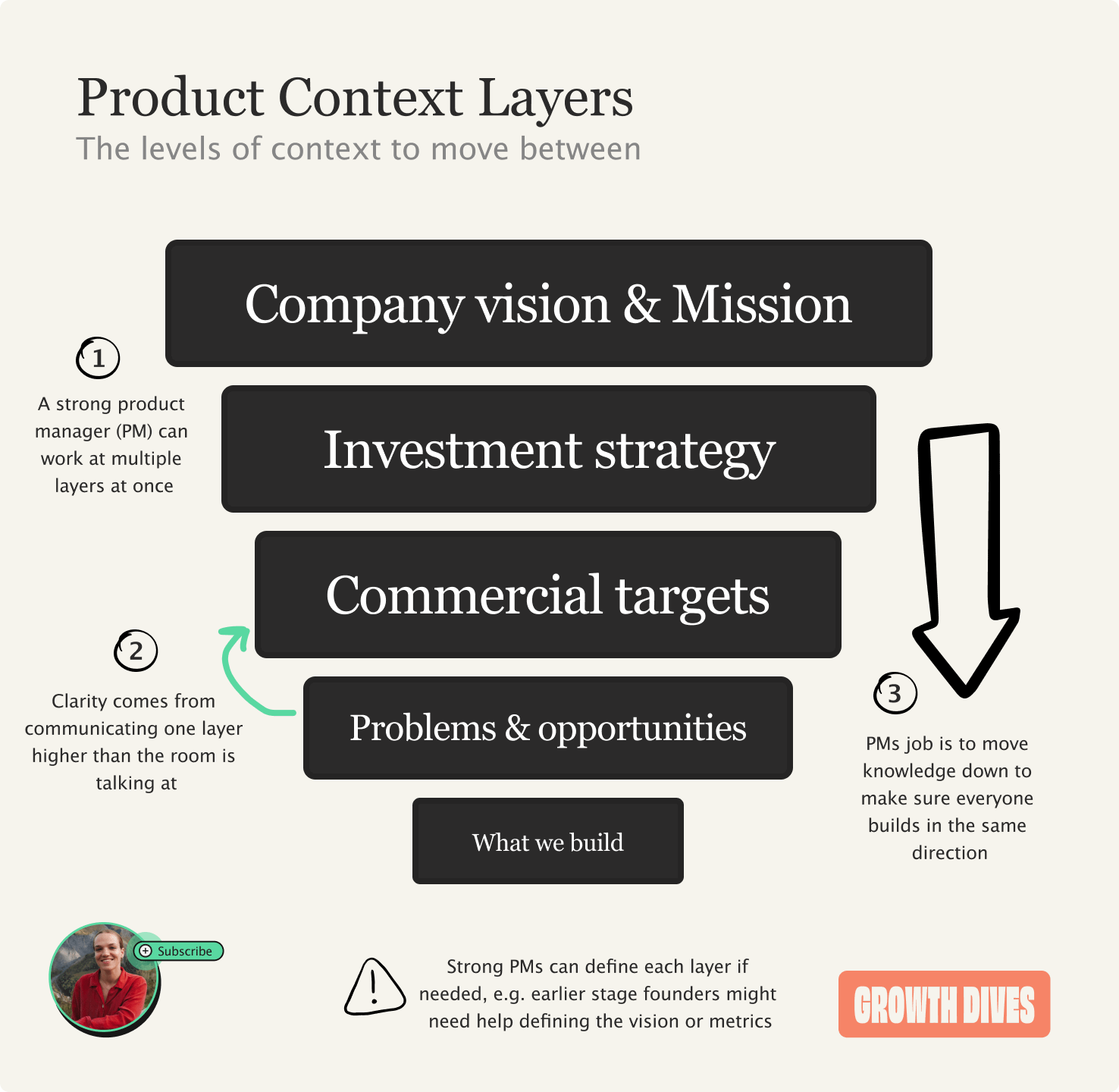
A trick: always talk one context level higher than the room. If people are arguing, bring them back to the problem. If they’re arguing about the problem, bring them back to the target it serves. If they’re debating that, go back up to the investment strategy and timeline.
Skill 2: Synthesis and Summarization
With AI, there’s a lot more noise and contrasting opinions. Everyone can be enabled now: there’s prototypes, there’s salespeople building things, there’s data artifacts everywhere. But you’re able to look across it all and have your own point of view about what matters.
You’re able to take vast amounts of information from different sources (data, interviews, investors, design, competitors) and distill it into what matters.
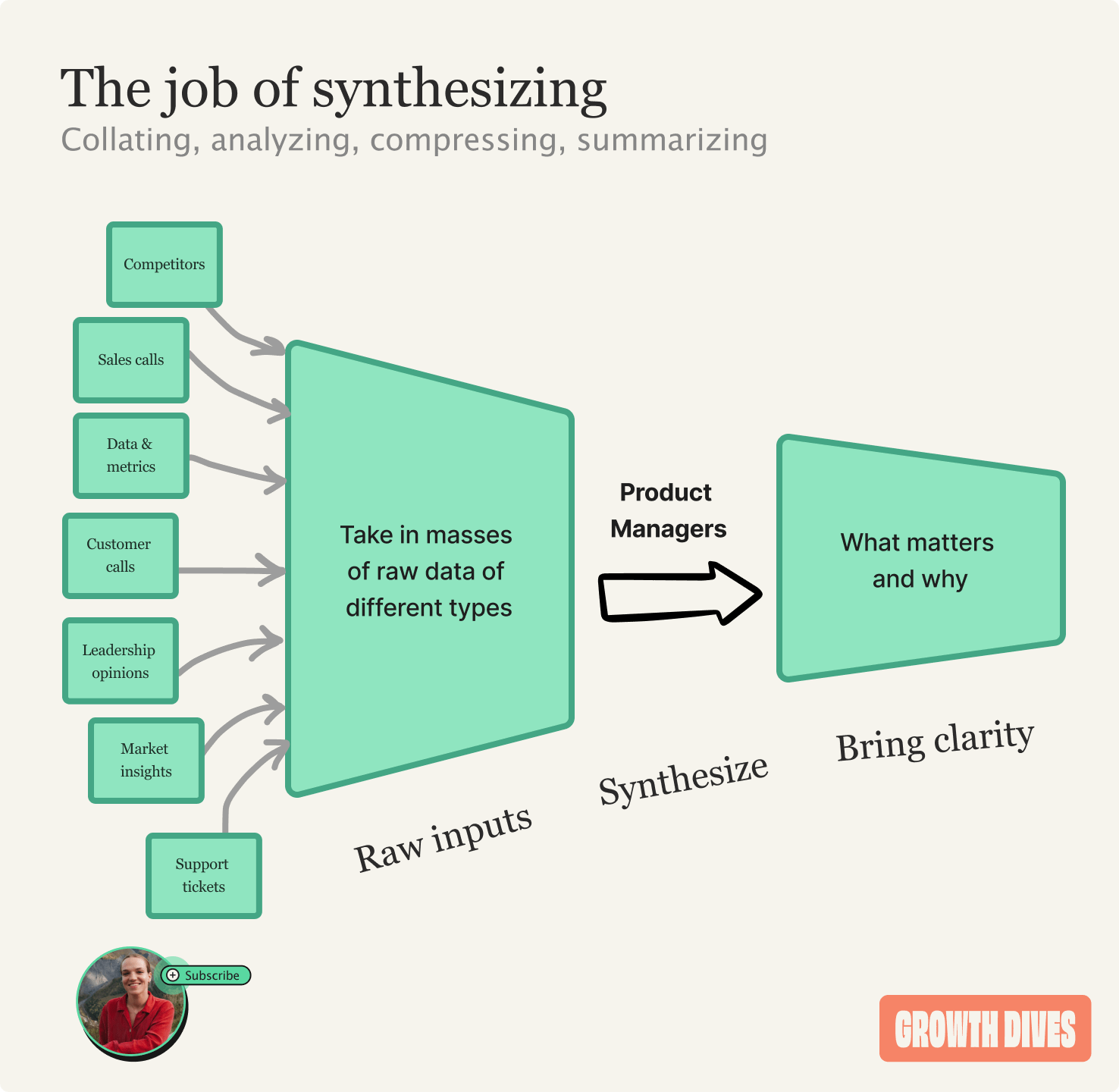
Before distilling, you stress test it all. Make sure the sources in are rigorous and you work out what's true. You can QA things that go live at speed, find the needle in the AI slop, and catch the one wrong number in an ever-growing pile of noise. AI makes it easy to produce a lot. Someone has to check it’s right (i.e. you).
Personally when I’m joining a new squad, or starting a new problem I need two weeks for this process, involving:
5-10 customer interviews to understand the problem
Data analysis on the funnel, cohort behaviour
Sales + success thoughts on the topic (which often match interviews)
The current UX/state of play for the product (what’s live - which is often harder to get than it sounds)
Sometimes: how competitors solve this problem
Out of this, I have a point of view (normally a board or deck or notion). I communicate it and get people onboard. Which is the next part.
A good test: can you explain something in three sentences to someone who wasn’t in any of the original conversations, and they can get it?
Skill 3: Stakeholder management
You know who cares about what and why. You understand the sequencing of who needs to be in the loop when. You prep people ahead of time, get them on side, and you know who to align at what stage.
No one should be blindsided by a decision. The people who could torpedo your plan hear about it early and 1-1 before the room does. It feels slow, but it’s quicker than unpicking a decision or going round in circles later.
Here's the process I use:
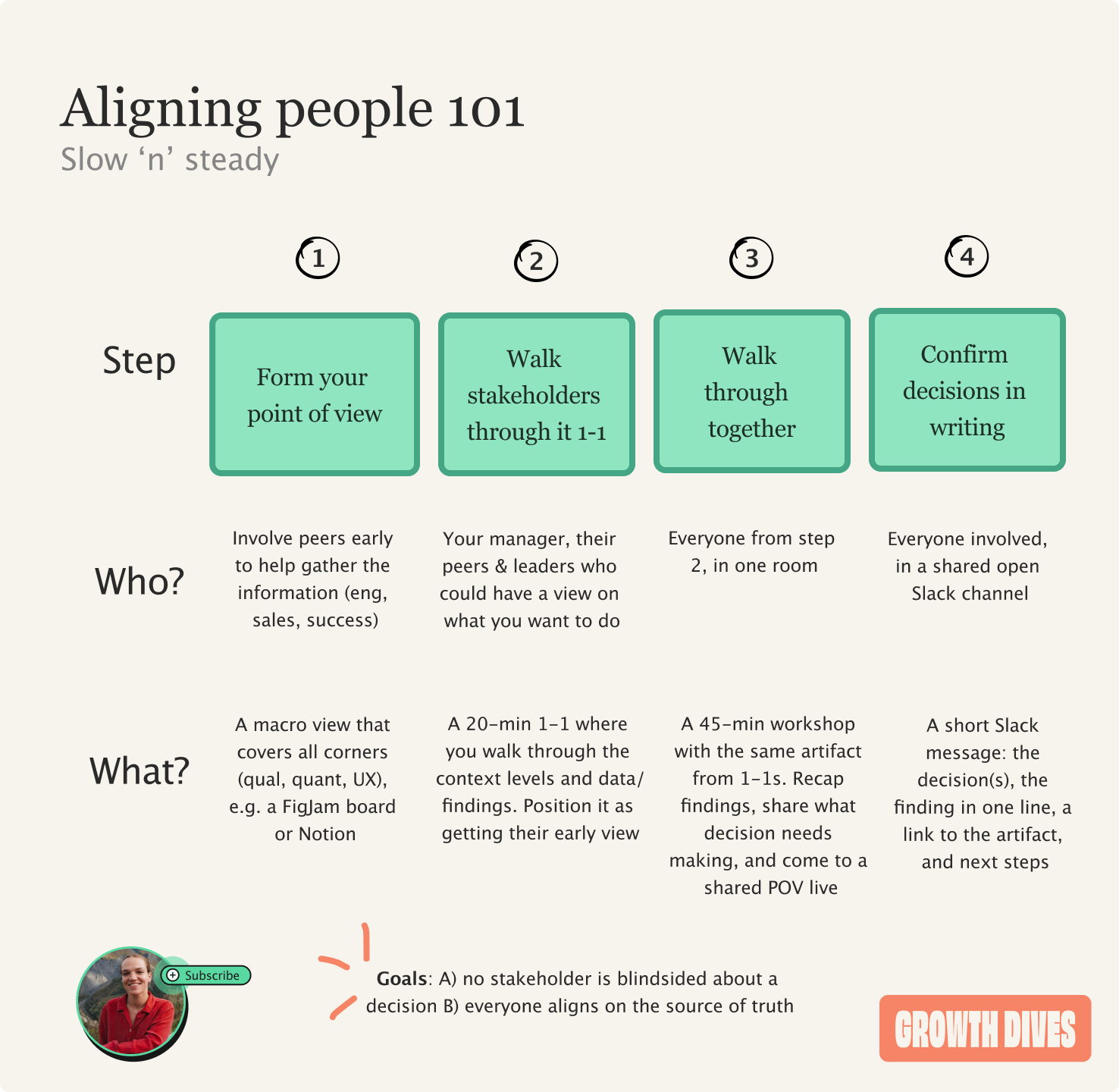
A good test: if someone important is hearing about a decision for the first time in a group meeting, you've left it too late to inform them.
These skills are most of the value I bring. It took me a while to see that, because the PM role tends to absorb whatever nobody else picks up: other people’s slack, or the company’s. That’s when you slide into project management or delivery. It’s useful work, but it muddies where the real value is.
So back to the question, what is the role?
My job is to be the business and customer expert. More than that, it’s to be the person who bring clarity and context, and who communicates the vision to keep people building in the right direction.
The faster AI makes everything go, the faster strategy goes out of date and the more I need people to make good calls without me. The job is increasingly about handing people the customer problem and the context, then letting them sort it out themselves.
What a day looks like: I talk about customer problems a lot. If talking doesn’t work, I draw it out. I show data and videos so everyone has the same shared view - eyeballs on the data and customers (not some second-hand regurgitation). I repeat the vision over and over. I repeat the company direction and priorities over and over. I spend a lot of time aligning people and talking.
I do a fair bit by hand. If I need to understand something deeply, I do it myself. If it repeats, I delegate it to AI.
I wrote this to get it clear in my own head. So next time I have the same convo:
Engineer: What do you do, Rosie?
Me: I’m the business and customer expert in the team. I turn chaos into clarity, so everyone knows what we’re doing and why.
That’s my definition. If you’ve got a better one, reply and tell me. I’m still working on mine!
P.S. Shoutout to the reader who recognized me on the tube! Made my day 🥹
P.P.S Thanks to those who booked a call in the past couple of weeks, great to get to chat to some of you about growth & product. If you’d like a call just hit reply and I’ll send you my calendly link