


I wrote my first ever article on Feb 23rd, 2023.
To my newbie delight, the article took off with 9,000 views and 4,000 reads.
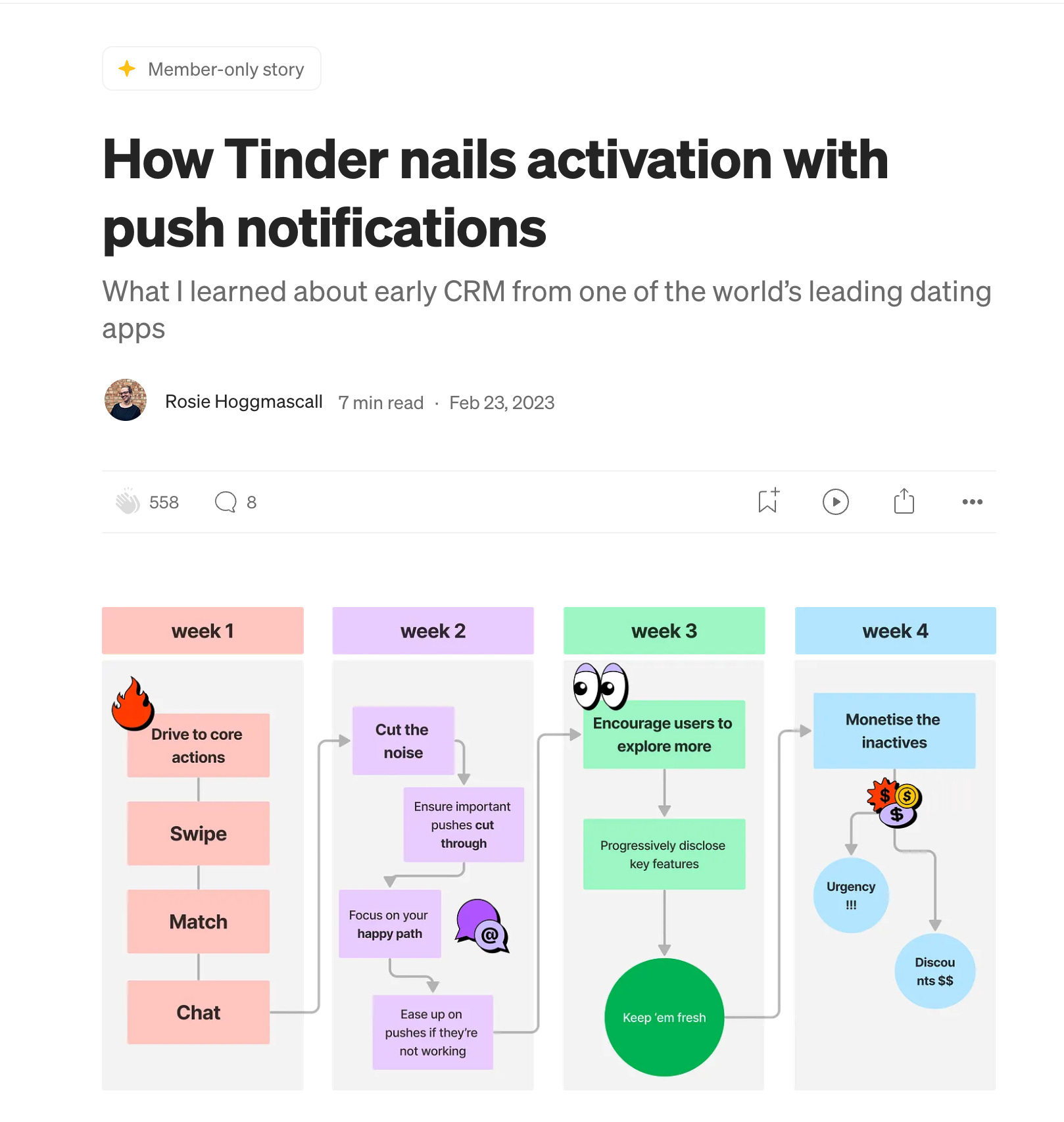
More than that, the feeling of getting something coherent on paper and freeing up brain space for deeper thinking was so, so satisfying.
So, I kept writing.
A few months later I had two viral articles in a row.
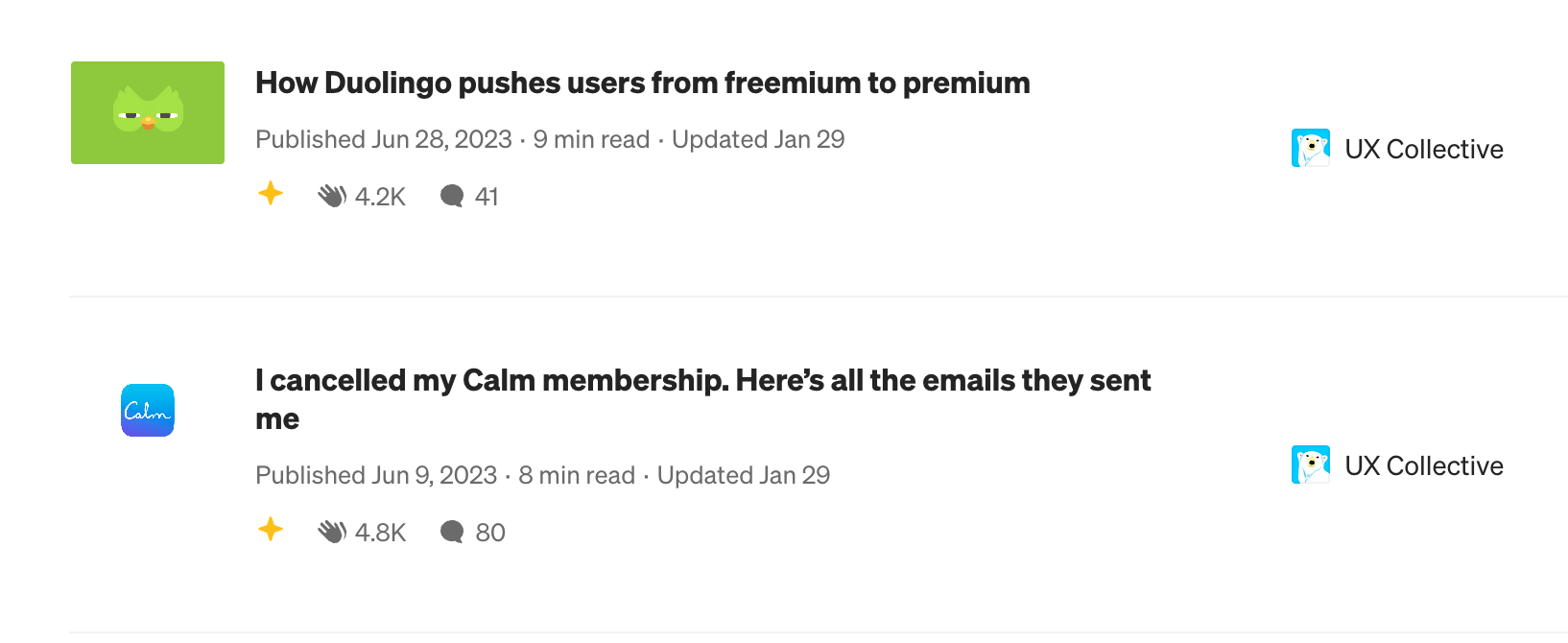
Fast forward 2.5 years, 87 articles, 720,800 total views, 16,000 followers, $11,000+ in earnings, and I am done with Medium.
From a product perspective, this is a really interesting change because the switching cost is so high (having created a writing routine and spent 300+ hours on the platform).
To understand how I reached this point, we’ll look at the product choices that shaped the experience over time. We’ll see that three things have an outsized impact:
Monetization strategy: how remuneration works (and doesn’t) on medium, and how it incentivizes the wrong things
Trust & safety: the impact of bad actors on the writer experience
Autonomy and reactance: how Medium’s locking down of audience information was the last straw
Each of these has a direct impact on one thing above everything else: writer satisfaction.
And writer satisfaction is the foundation of any writing platform.
Why writer satisfaction matters
Writing platforms are networks. What this means is that each new writer or reader has the potential to improve the experience for everyone else, creating a positive feedback system.
According to Andrew Chen’s book ‘The Cold Start Problem’, there are two sides to every network:
The ‘hard’ side of the network: a smaller group of people that supply the value. It’s called the hard side as they’re generally harder to get into your product.
The ‘soft’ side of the network: the rest of the people that are there to consume the value that the hard side provides. Creating a value cycle between the two sides.
Some examples:
Uber: hard side = the drivers. Soft = the passengers
Patreon: hard side = content creators. Soft side = the viewers.
Tinder: hard side = the most desirable profiles. Soft side = the masses matching with them.
Vinted: hard side = clothes sellers. Soft side = buyers.
Airbnb: hard side = hosts. Soft side = guests.
Udemy: hard side = the teachers and course creators. Soft side = students
Reddit: hard side = posters and moderators. Soft side = readers and lurkers.
For writing platforms like Medium, Substack, Beehive and ConvertKit, the hard side of the network is the writers, the soft side of the network is the readers.
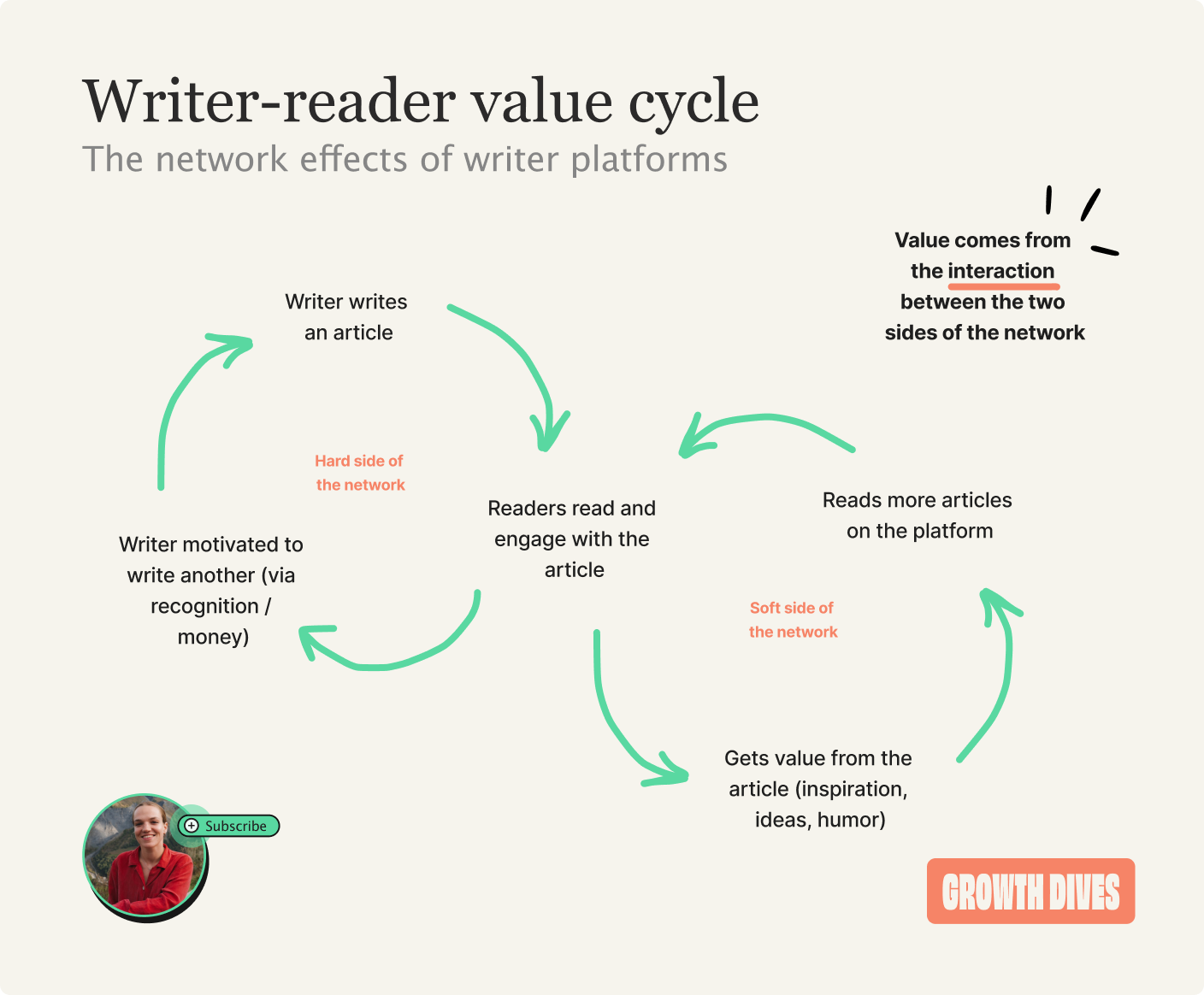
What most people focus on with networks is how hard it is to get them started (hence the name of Andrew’s book: ‘the cold start problem’).
But once a network reaches scale, the priority becomes keeping the hard side engaged, because they are the group that makes everything else work.
When Uber drivers are unhappy, they drive for another product. Once that happens, there’s no cars available. Once there’s no cars available, the passengers follow suit, jumping to another solution versus standing on the pavement. The core user experience then tanks, and retention falls as a result.
For Medium, the challenge is not scale.
There are over 100,000 writers, 2.4 million stories published a month and over 1 million paying subscribers as of 2024.
At their $50 a year pricing, this puts them at around $50 million annual recurring revenue. If the valuation is 20X that, it puts it at around $1 billion valuation.
Which means the problem is not the size of the network.
It’s something else.
The first problem: a monetization strategy that ignores reader-writer relationships
Medium’s monetization model is built on one subscription being shared between every writer on the platform.
Each month, Medium takes the total subscription revenue and divides it through a distribution model based on read time, engagement points, reads from external sources, and a boost bonus chosen by editors.
In reality, few medium writers can explain exactly how the payouts work. Even people who have been on the platform for years are still in the dark:
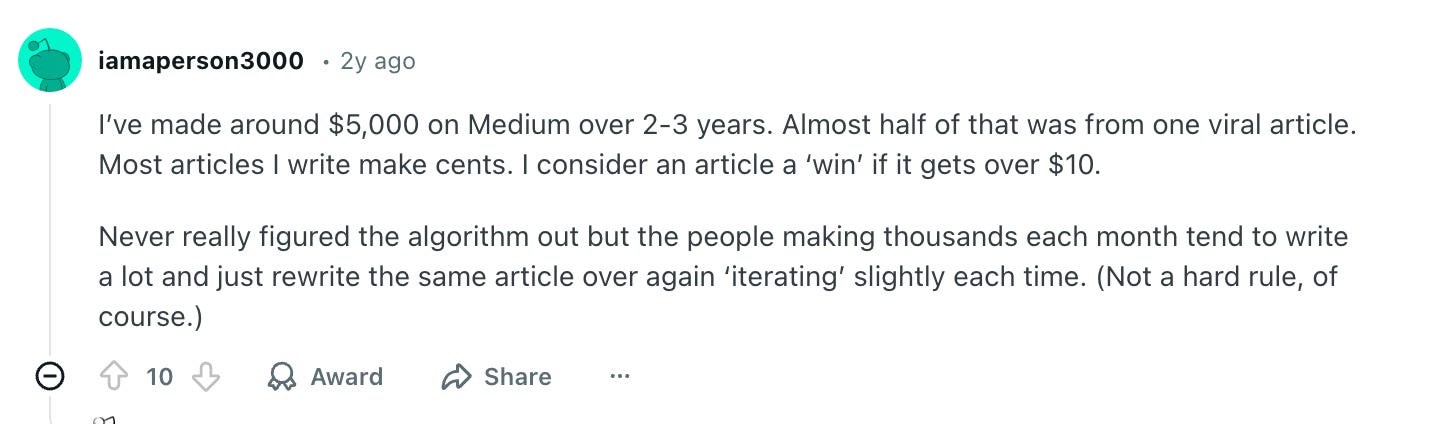
For the small group of writers who do earn, the income is almost impossible to predict from month to month.
After writing articles consistently over 2.5 years, I’ve seen:
Average earnings: $138.83 per article
Highest: $1,433.00 (I cancelled my Calm membership. Here’s all the emails they sent me)
Lowest: $0.10
Bottom 25% of articles: $12.37
Top 75% of articles: $169.88
A few strong articles lift the entire average, and everything else sits far below it.
On a month-by-month earnings basis, it’s a similar trend.
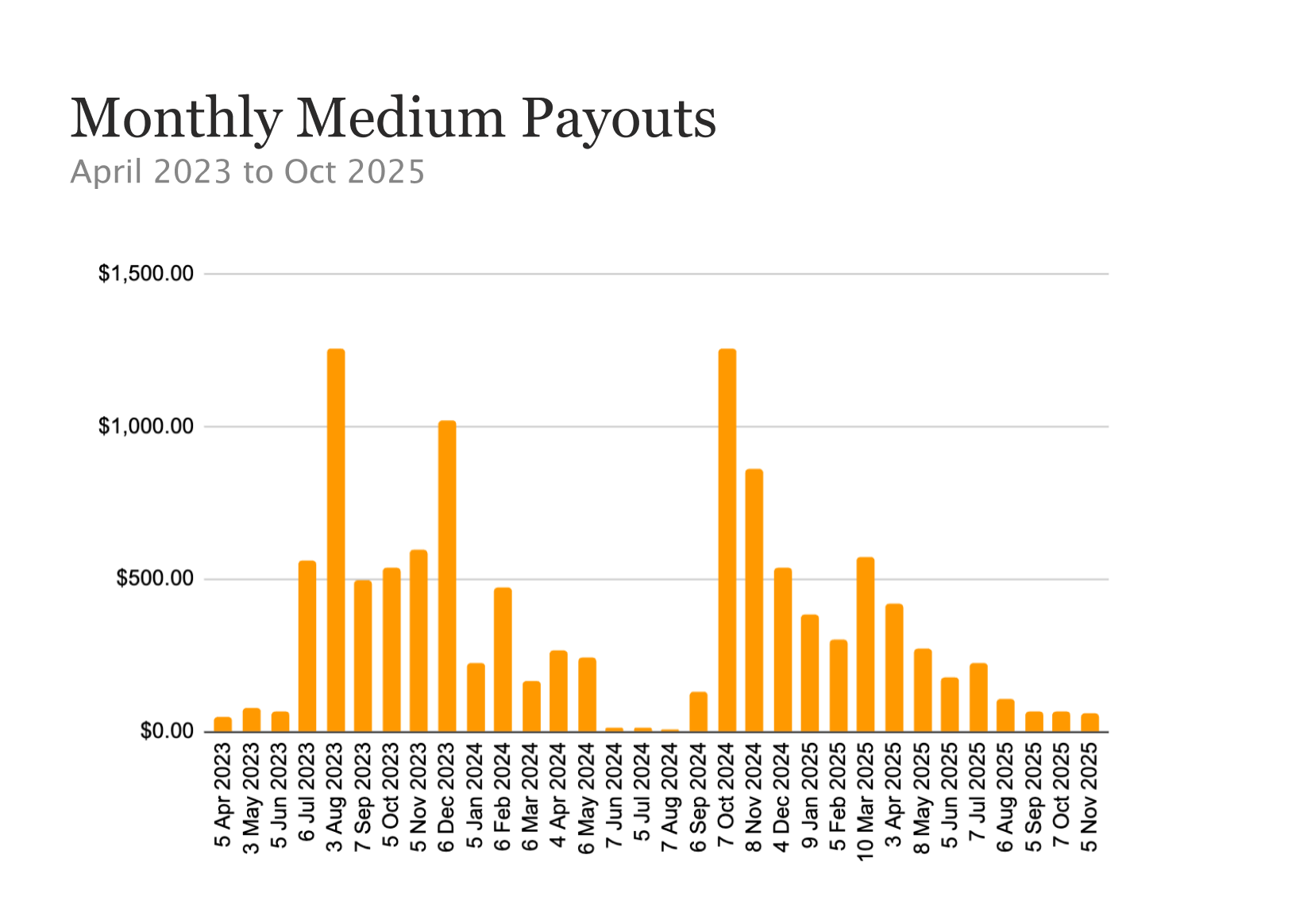
Average month: $358.74
High: $1,250 (Oct 2024 and Aug 2023)
Low: $8.56 (three months around the $10 mark)
What I see here: A few high-earning spikes, a cluster around the mid-range, and a long tail of low-earning months.
The real issue is not the amounts, but the unpredictability.
If earning is your goal, this bumpyness pushes writers to cross post elsewhere to spread risk. Virality is the only reliable path to earn on Medium — and that is impossible to produce consistently.
Zooming out reveals a much bigger flaw too.
Medium’s monetization model keeps readers and writers separate. If a reader loves a specific writer, there’s no guarantee their subscription supports their work.
Instead of rewarding relationships or loyalty, the pricing model rewards reach, length and hooks. What you end up with is content that reflects this pricing model:
Click bait
Exaggerated stories
The lower-quality content has been noted by both readers and writers alike, with one subscriber writing on reddit:
Is anyone else disappointed by how many clickbait stories Medium promotes?
I’ve been a paying Medium member for years now, and recently I keep seeing clickbait stories on my home feed. They often have very attractive titles like: « I made xxx$ with ChatGPT and Gumroad », «I published my first book using AI and it’s selling every day »
The top comment crystallizes the writer sentiment in a nutshell:
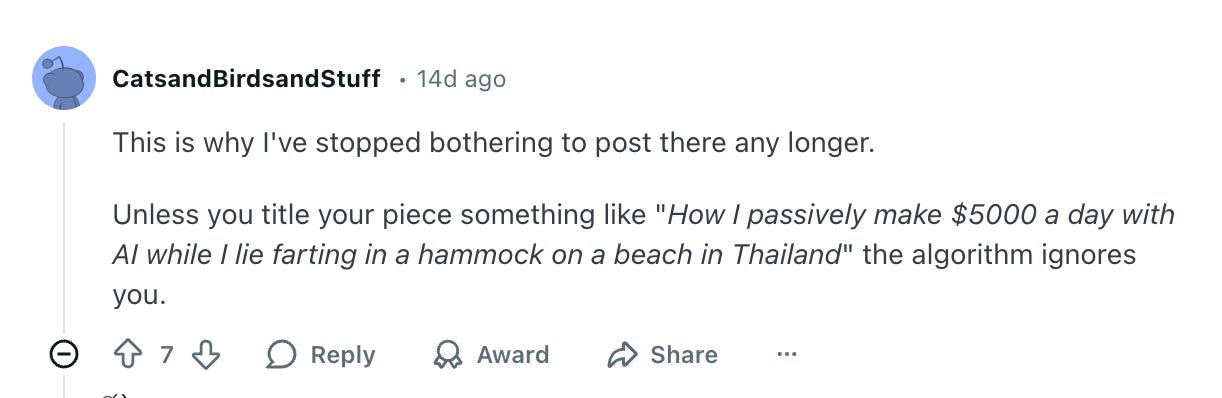
The core issue is that people are not subscribing to you. They are subscribing to Medium, and Medium decides where their subscription money goes.
This shows a lack of model-market fit: where the monetization model doesn’t fit the way that people use the product, creating a ceiling for growth.
It also means the lifetime value of a paying Medium subscriber is capped. There’s one subscription per reader. On Substack or Patreon, a reader/consumer can subscribe to ten creators, or a hundred if they want to. That means LTV on those platforms could be $1000s per year.
The multi-subscription model scales much better, and also creates competition between writers.
Writers know they have to consistently produce great content to convert their readers, else they’ll go to a competitor publication. The inputs and outputs are clear. The incentive is aligned with the work, and the monetization strategy, not with chasing an algorithm for reach.
Even if earnings had been predictable, another issue was already eroding the experience behind the scenes.
Problem number 2: Bad actors and bots
I know many people who don’t write to earn, they write for the enjoyment.
Part of that enjoyment is replying to comments from engaged readers. It’s what keeps the value loop spinning.
As a writer, I loved spending time replying to comments.
Then the comments changed.
I saw more spam, bots, schemes, catfishing and fake profiles. There was a point where I was reporting comments more than replying.
At the height, I had a 70:30 bot to real-comment ratio.
This is the kind of thing that kept showing up:
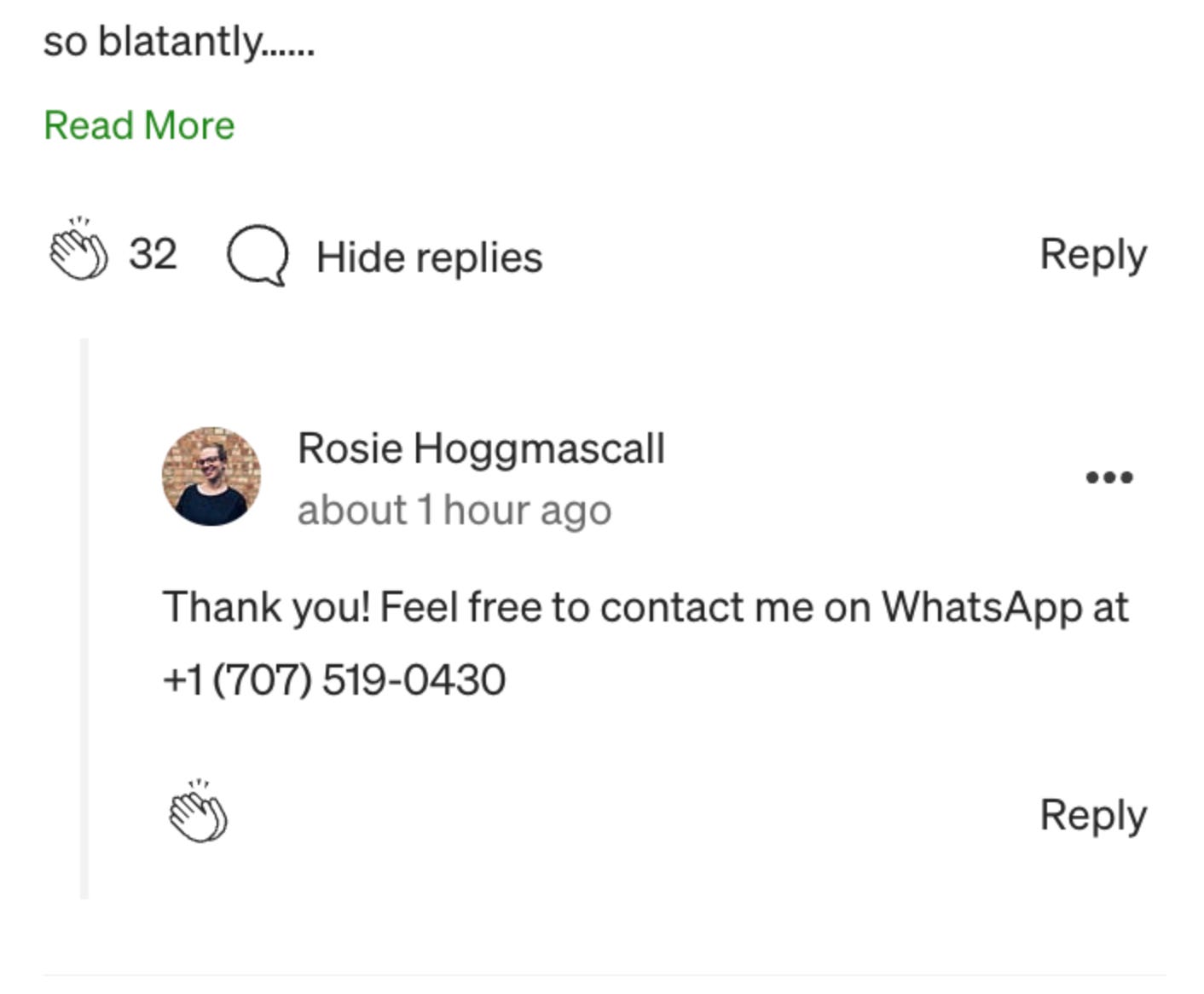
I’m not alone here either. The bots are all over medium.
Because of this extra mental load, I stopped replying to comments. Instead of being a place that gives me energy, the comment section was admin.
I’ve seen this happen before with social networks. I once worked for a social network app, and we ran the Product-Market Fit survey to work out where we could improve retention.
For the people who were on-the-fence about the product, the two big things they disliked were:
Bullying and bad actors*
Notification spam
*‘Bad actors’ is an umbrella term used in product to describe accounts that breach the guidelines, they are often made for malicious purposes (spreading misinformation, fraud, or abuse).
At the beginning, teams worry about being able to scale enough to get value in the network. They open the gates and make it easy to get in and get up to speed. But if your trust and safety team doesn’t scale at the same rate, bad actors will start to eat away at your retention. Because ultimately, they erode trust.
To solve this, you need people whose whole job is to improve how safe the product feels. That involves working on community guidelines, content moderation, user authentication flows, reporting flows, detection algorithms, banning flows, customer support and more.
Bad actors are one of the biggest risks to retention for social products.
It’s the reason I don’t sell on Facebook marketplace anymore. Too many schemes. Too much reporting.
But, with low pay, unclear earnings payouts, and a load more admin to do reporting bots, I still wasn’t willing to switch.
Until…
The final straw: No audience ownership
Having spent 2.5 years growing an audience to 16,000, I went in to look at all my followers and email subscribers the other day.
I tried to download the 1,300 email subscribers. I opened the CSV and saw 25 names….
Turns out I can only download the people from before April 2025. After some searching, I found that Medium had removed the ability to download your email subscribers earlier this year.
Then it hit me: my audience is stuck on Medium.
If someone subscribes by email, I can’t contact them directly. The only way to reach them is by posting publicly on Medium and checking a box ‘email to my subscribers’.
If they’re followers, I don’t know what they see. I don’t know how often my work appears for them, or whether it appears at all: they might receive a push notification, they might see me in their feed. Maybe not.
After all that time and effort, I realized that the audience I had built wasn’t mine. It belonged to Medium.
As one redditor put it:
Hidden subscriber lists taught me: Audience access > Audience size.
And that was the moment it all fell into place in my mind (and why this article took so long to write).
I realized wasn’t just at the whim of the platform for payouts. I was at the whim of the platform for audience access 😭
This was the final straw because there’s no future where I can write with ease, own my audience, and be rewarded fairly for it on Medium.
To conclude: Medium’s product strategy has lost sight of its users
Ultimately. Medium feels like it has lost Product-Market Fit. Writers are losing value from the platform, and readers struggle to find content they actually want to read.
It comes down to a poor monetization strategy that shaped the wrong incentives, which breaks the value loop between readers and writers.
The interaction between readers and writers is what keeps a writing platform going. With Medium, there are no features designed to strengthen the relationship between both sides of the network. As a writer, I have few tools to engage my audience, and as a reader I can’t directly support the authors I like.
What’s left is the black box of Medium’s remuneration model and their suggested reading algorithm, both of which have lost the trust of the end user.
So what’s next?
For the last year, I’ve been building an owned newsletter audience on ConvertKit, whilst also posting on Medium. Funnily enough I wanted maximum flexibility with my audience and the platform (perhaps as a subconscious reaction to Medium…).
Now I need the middle: enough automation that I don’t have to think about templates (like I do on Kit), but enough autonomy that I can tailor, create and give things to my audience if I want to (unlike Medium).
So, goodbye ConvertKit and Medium, hello Substack 👋
v interesting example of how the monetisation model impacts the other fits - and selfishly i’m pleased you’re here because this is where i spend time (i used to click through on emails to read your blogs, but email is not a place i like to hang out and substack is)
Hey, great read as always. What model do you envision for writer satisfaction? Always so insightful.